Securlando
Free Capsule
Free Capsule
Couldn't load pickup availability
1. Problem Statement
Cybersecurity can appear difficult when unfamiliar terms and technical concepts are introduced without enough context. Learners may encounter scattered explanations without seeing how individual ideas connect. This can make it harder to understand why certain defensive measures exist or how different security events relate to one another. A lack of structured foundations can also create confusion when studying more detailed topics later. Free Capsule addresses this starting-stage challenge through an organized introduction to core cybersecurity concepts.
2. Solution
Free Capsule organizes introductory cybersecurity topics into a clear learning sequence. Each section introduces one concept before connecting it with related defensive ideas. Practical examples help explain how security principles appear in everyday digital environments. Short review activities encourage learners to examine situations rather than memorize isolated definitions. The course creates a foundation that can support continued study across later Securlando tiers.
3. What's Inside
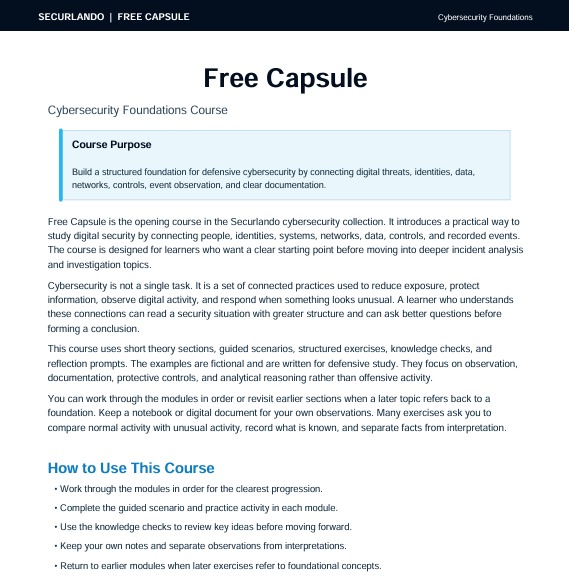
The course begins with an overview of cybersecurity and the role defensive thinking plays in protecting digital environments. Learners examine common categories of digital threats, basic security terminology, data protection concepts, authentication principles, network awareness, and the relationship between users, devices, information, and systems.
Later sections introduce threat recognition, common attack patterns at a conceptual level, security controls, incident awareness, basic risk evaluation, and simple approaches to documenting observations.
Each module includes structured explanations, short examples, reflection questions, and practical learning tasks. The material focuses on understanding why security measures are used and how different concepts connect rather than relying only on definitions.
4. Who Is This For?
Free Capsule is intended for learners beginning their cybersecurity studies, people exploring the field before choosing a deeper learning route, and learners who want to review foundational security concepts in an organized format.
No previous technical background is required.
5. What You'll Learn
- Core cybersecurity terminology and concepts
- Basic categories of digital threats
- Defensive security principles
- Data protection fundamentals
- Authentication and identity concepts
- Introductory network security awareness
- Basic threat recognition
- How security controls reduce exposure
- Introductory incident observation
- Simple methods for organizing security findings
- How different security concepts connect within a digital environment
- A structured approach to reviewing unfamiliar security situations
6. 30-Day Refund Policy
Free Capsule is provided at no charge. No payment is collected for this tier, so there is no purchase amount to refund.
Learners can review the course structure and introductory materials before deciding whether they would like to continue with another Securlando learning tier.
- 📘 Digital file available after purchase
- 🗂️ Long-term availability
- 🔒 Secure checkout
- 🧩 Content updated in 2026
Self-paced learning overview
What format are Securlando courses provided in?
What format are Securlando courses provided in?
Securlando courses are organized into structured modules with written materials, explanations, practical examples, review sections, and guided cybersecurity exercises. Each tier follows its own learning scope while connecting naturally with the broader course collection.
Do I need previous cybersecurity knowledge?
Do I need previous cybersecurity knowledge?
Entry requirements depend on the selected tier. Earlier tiers introduce foundational ideas, while later tiers explore broader defensive concepts, analysis methods, system behavior, and security scenarios. Learners can review the course outline before choosing a suitable starting point.
Can I study at my own pace?
Can I study at my own pace?
Yes. The materials are designed for independent study, allowing learners to move through sections according to their own schedule and revisit topics when additional review is useful.
Share