Securlando
Slate Guide
Slate Guide
Couldn't load pickup availability
1. Problem Statement
As cybersecurity knowledge grows, isolated observations are no longer enough to understand a security event. Learners need to examine how activity across several areas can connect and influence the overall situation. Identity behavior, network communication, system changes, and data movement may all provide different pieces of the same event. Without an organized review process, important relationships between these observations can be overlooked. Slate Guide addresses this challenge by teaching learners how to combine multiple sources of information into a structured defensive analysis.
2. Solution
Slate Guide introduces a broader method for examining security activity across connected digital environments. Learners study how to identify relevant observations, compare them, and place them within a logical sequence. The course uses fictional scenarios to demonstrate how one unusual event may lead to additional findings in another area. Learners also practice distinguishing primary observations from supporting context. The material gradually develops a repeatable approach for reviewing more detailed cybersecurity cases.
3. What's Inside
The opening modules explore the relationship between identities, devices, network activity, stored information, and security controls. Learners examine how these areas can be reviewed separately before combining them into a wider security picture.
The course then introduces behavioral baselines. Learners study how expected activity can be compared with unusual patterns, including unexpected account actions, abnormal communication behavior, unusual resource use, and changes that occur outside an expected sequence.
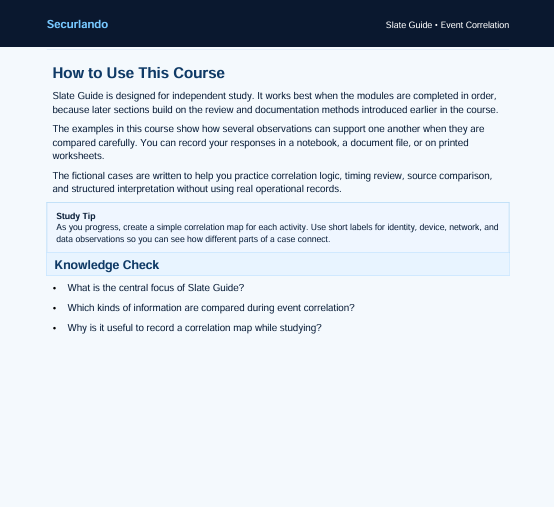
A dedicated section covers event correlation. Learners practice connecting timestamps, identity activity, system observations, and network events to understand how multiple findings may relate to one another.
Slate Guide also expands incident documentation. Learners build structured timelines, categorize observations by relevance, record unanswered questions, and create concise summaries that separate known facts from analytical interpretations.
Scenario-based exercises require learners to examine several pieces of information at once. These activities encourage careful reasoning, prioritization, and structured review rather than immediate conclusions.
4. Who Is This For?
Slate Guide is intended for learners who understand foundational cybersecurity concepts and basic threat analysis.
It is suited to those interested in defensive analysis, security monitoring, incident review, digital investigation, and understanding how multiple security observations can be connected.
5. What You'll Learn
- How identities, devices, networks, and data interact
- Methods for identifying unusual behavioral patterns
- How to compare expected and unexpected activity
- Basic behavioral baseline concepts
- Event correlation methods
- How to connect related timestamps and observations
- Methods for reviewing identity-related activity
- Network activity analysis fundamentals
- System-change observation methods
- How to categorize security findings by relevance
- Structured timeline development
- Methods for recording unanswered investigative questions
- How to distinguish facts from interpretations
- Techniques for combining several information sources
- How to prepare organized incident summaries
- A repeatable process for reviewing multi-stage security scenarios
6. 30-Day Refund Policy
Slate Guide is a paid Securlando course. Refund requests may be submitted within 30 days of purchase in accordance with the store's stated refund terms.
Learners are encouraged to review the course scope, included materials, and expected knowledge level before purchasing so they can determine whether the course fits their current learning stage.
- 📘 Digital file available after purchase
- 🗂️ Long-term availability
- 🔒 Secure checkout
- 🧩 Content updated in 2026
Self-paced learning overview
What format are Securlando courses provided in?
What format are Securlando courses provided in?
Securlando courses are organized into structured modules with written materials, explanations, practical examples, review sections, and guided cybersecurity exercises. Each tier follows its own learning scope while connecting naturally with the broader course collection.
Do I need previous cybersecurity knowledge?
Do I need previous cybersecurity knowledge?
Entry requirements depend on the selected tier. Earlier tiers introduce foundational ideas, while later tiers explore broader defensive concepts, analysis methods, system behavior, and security scenarios. Learners can review the course outline before choosing a suitable starting point.
Can I study at my own pace?
Can I study at my own pace?
Yes. The materials are designed for independent study, allowing learners to move through sections according to their own schedule and revisit topics when additional review is useful.
Share